


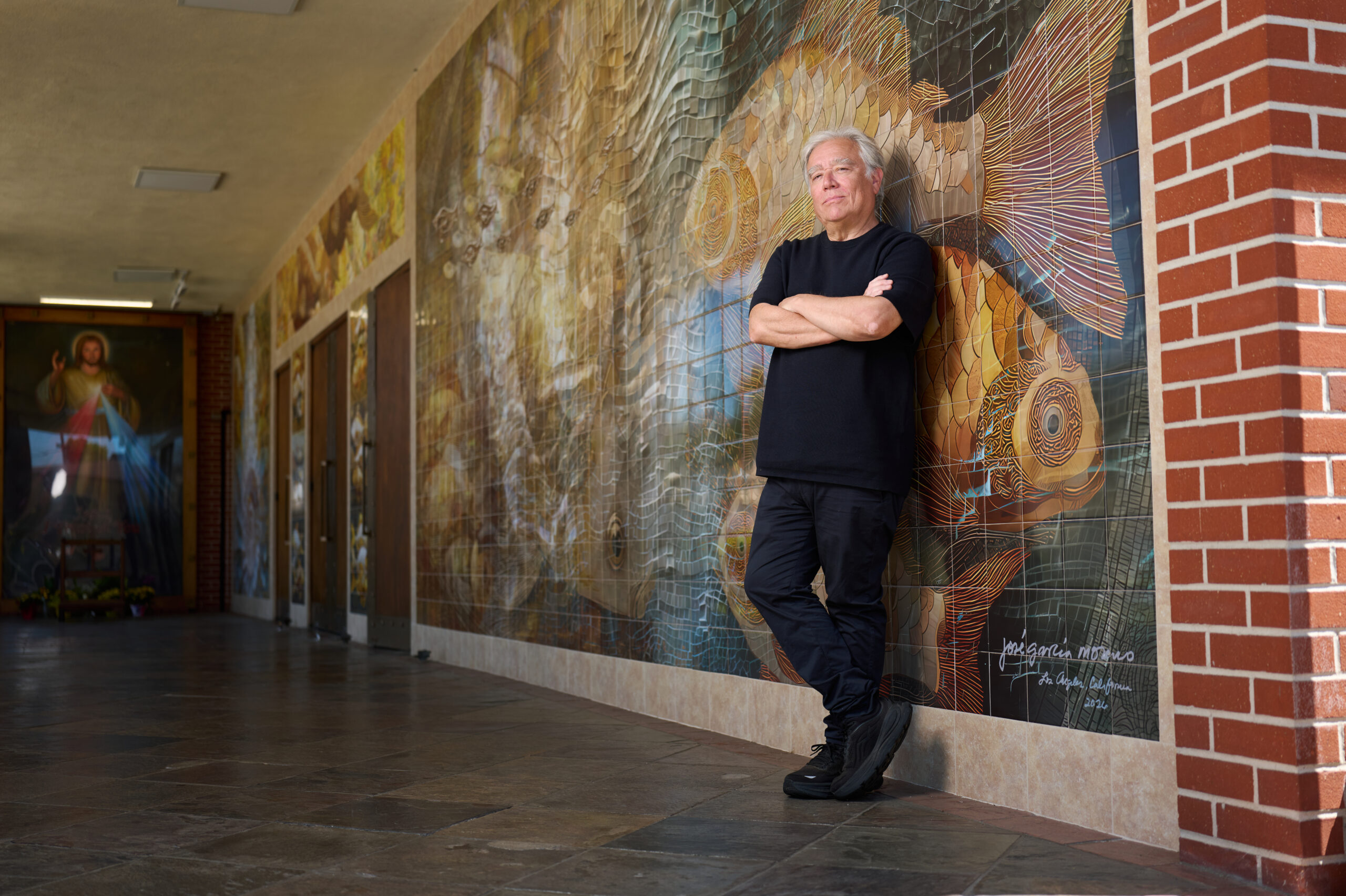
José García Moreno, director of LMU’s Academy of Catholic Thought and Imagination, has completed a large-scale ceramic mural at Holy Family Catholic Church in Artesia, California.
The mural, which measures 10 feet tall and 52 feet wide, is made up of close to 1,500 six-inch ceramic tiles. The project took two years and was completed in summer 2026.
The project was inspired because of García Moreno’s work at LMU, “Anima Mundi: The Soul of the World,” a live video-mapping show projected onto the walls of Sacred Heart Chapel in 2023, that celebrated the 50th anniversary of the merger of Loyola University and Marymount College, and which is available on YouTube.
Luis Proença, S.J., a professor in the LMU School of Film and Television, has also been presiding at Holy Family for more than 30 years. He recommended that Father John Cordero, pastor of Holy Family Catholic Church, watch “Anima Mundi” and after seeing the video, Cordero reached out to García Moreno with an idea for a mural at the entrance of the church.
Holy Family has deep roots in Artesia’s Portuguese community and serves a diverse congregation that includes Portuguese, Filipino, Korean and Latino Catholics. Cordero asked that the mural incorporate Matthew 28:19: “Go therefore and make disciples of all nations.”
The history and diversity of the parish helped García Moreno develop the concept for the mural. Portuguese and Filipino cultures have strong ties to the ocean, while Portugal has a long tradition of decorating churches with azulejos, painted ceramic tiles.
“The concept of the ‘fisher of men’ immediately came to mind,” García Moreno said. The mural includes images of fish and shells, along with the movement of light as a metaphor for the action of the Holy Spirit.
García Moreno had previously experimented with ceramic tiles on a smaller scale. For this project, he collaborated with Enduring Images, a group of artists in Colorado, to produce the nearly 1,500 tiles.
For García Moreno, creating art for a sacred space has high stakes. “It is their temple, their sacred space, held with a tremendous amount of devotion by so many individuals,” García Moreno said. “Fortunately, the reception went beyond my wildest expectations.”
For Proença, the mural reflects the spiritual identity of the parish itself. He describes the spiral woven through the design as “a creation that doesn’t close on itself,” but instead as “all revolving, all creation, and all renewal.” It represents the diversity of their parish.
“My hope is that people encounter something beautiful that invites them to pause, step out of the rush of daily life, and take a quiet moment to reflect on their own spiritual path,” García Moreno said.