“When I got out of prison, it was my dream to come to college,” said Alexander Singer, a graduate of the Center for Juvenile Law and Policy’s Independent Forensic Gang Expert College (IFGEC) and LMU Loyola Law School (LLS) intern. “But there were massive obstacles. Schools didn’t want people who were formerly incarcerated on their campuses. When I learned about the Gang College and its mission to give people a voice, it inspired me and helped me bridge the gap between academia and becoming an attorney.”
Singer was one of over a dozen speakers gathered to launch the Prison-to-Prosperity Pipeline, an all-day event hosted by the Loyola Center for Conflict Resolution (LCCR) and the Center for Juvenile Law and Policy (CJLP), both housed at the Loyola Social Justice Law Clinic program (LSJLC) at LLS. In a series of panels, faculty, staff, and community partners discussed how to deepen communication and collaboration among LMU programs that support formerly incarcerated people.
Adrian Caceres, a second-year Ph.D. student at UC Irvine, completed both the IFGEC and LCCR’s mediation training. He credited those experiences with helping him discover professional opportunities and a sense of community.
“Going through this process and program, you guys made me feel seen and embraced, like I belonged,” he said. “Being here helped me change the narrative.”
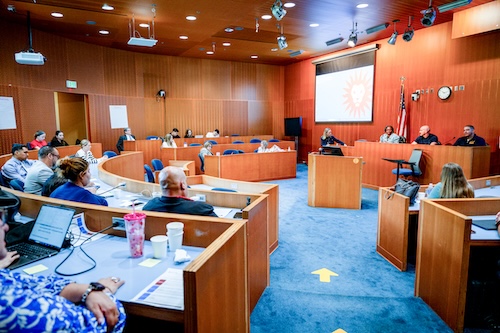
Changing the narrative, panelists agreed, necessitates more than just one program or pathway.
“When we certify our gang experts, it’s just the beginning,” said Professor Sean Kennedy ’89, Kaplan & Feldman Executive Director of the Center for Juvenile Law and Policy. “So much that comes after that could be addressed in our work together.”
Kennedy pointed to challenges such as imposter syndrome, the emotional demands of courtroom testimony, and practical needs like business management and tax preparation as opportunities to deepen support frameworks.
“The Loyola Social Justice Law Clinic program works to remove barriers to accessing and participating in educational and job placement programs and to train people with lived expertise to use that expertise to help their communities. Through partnerships with other programs, like LMU Extension, we can provide the additional resources necessary to begin a new chapter,” said Elizabeth Bluestein, director of the LSJLC.
Emerging from a pilot collaboration between LCCR and CJLP, the convening responded to needs identified in community listening sessions. “One group that demonstrated a strong interest in community-based prevention strategies, like conflict resolution training, were formerly gang-involved individuals,” said Sara Campos, director of LCCR. “LCCR led these trainings as part of an anti-hate grant aiming to prevent and mitigate community violence.”
For Angelee Kidd, opportunities following incarceration felt scarce. It wasn’t just the obstacles to finding work; it was the lack of guidance and direction.
“I don’t want to show up in a workplace where I have to hide parts of who I am,” she said. “Once I began to navigate opportunities here at Loyola, one class led to another.”
A graduate of LCCR’s dispute resolution mediation training program, Kidd has also received certificates in substance abuse counseling and peer mediation from LMU Extension programs, positioning her for a long-term career and supporting a trajectory of ongoing professional growth.
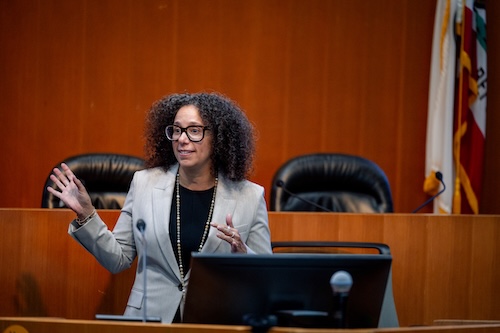
“Our commitment to the Prison-to-Prosperity Pipeline is an invitation to all of us to figure out how to do more,” said Brietta Clark, Fritz B. Burns Dean of the LMU Loyola Law School. “And how to strengthen connections between our campuses in ways that help us expand resources, expertise, and relationships that cement pathways from incarceration to education and community leadership.”
Dean Clark emphasized that meaningful solutions must be informed by the people they are intended to serve.
“The work needs to be shaped by the communities whose lived experiences are impacted by what we’re talking about,” she said. “The strength of a pipeline isn’t any single program. It is how we work together.”
LCCR was one of five mediation centers selected from across the country to receive funding for a two-year hate prevention initiative supported by the JAMS Foundation and the National Association for Community Mediation (NAFCM).