For graphic designer, curator, and educator Garland Kirkpatrick, visual communication is more than a creative practice. It is a tool for civic engagement, historical memory, and social critique. That conviction is at the heart of “autoethnographis,” Kirkpatrick’s exhibition at St. Edward’s University Fine Arts Gallery in Austin, Texas (September 30 – October 22, 2026).
As someone who came of age during the Civil Rights era, Kirkpatrick sees the exhibition as both a personal reflection and a response to the current moment. “The assault on our human rights, the rise of authoritarianism, the censorship of free speech, and the uncertain prospects surrounding the midterm elections prompted me to use this exhibition to reexamine my own engagement with the times as a visual designer. Tragically, we are still counting civilian lives lost,” says Kirkpatrick.
Spanning more than three decades of work, the exhibition unfolds along two paths. One direction begins with Side A/B, featuring Kirkpatrick’s photographs of the 2015 crossing of the Edmund Pettus Bridge in Selma, Alabama, alongside the first edition of “American Pie,” a self-published newspaper documenting the killings of Black citizens by police through printed posters and QR-linked content. The opposite path presents new poster works inspired by lyrics from The Staple Singers from the 1970s. The poster diptych, “Take the Sheet Off Your Face, Boy…” draws parallels between Ku Klux Klan hoods and the masks worn by ICE agents. A series of posters inspired by Nina Simone’s civil rights anthem “Mississippi Goddamn,” memorializes recent lynchings of African Americans in the South in 2025 and 2026. These narratives converge in a final gallery section honoring Lorenzo Salgado Araujo, who was killed by ICE agents in Houston, through Abrazos (The Embrace), a triptych created in the Mexican Milagro tradition. The installation is complemented by a section of student-designed yard signs.
In a companion workshop, students explored their own voices and perspectives on the issues shaping the election in response to the exhibition’s themes. “This engagement was particularly meaningful at St. Edward’s University, where a significant portion of the student population is Latino and the campus is situated in a politically conservative state,” Kirkpatrick says.
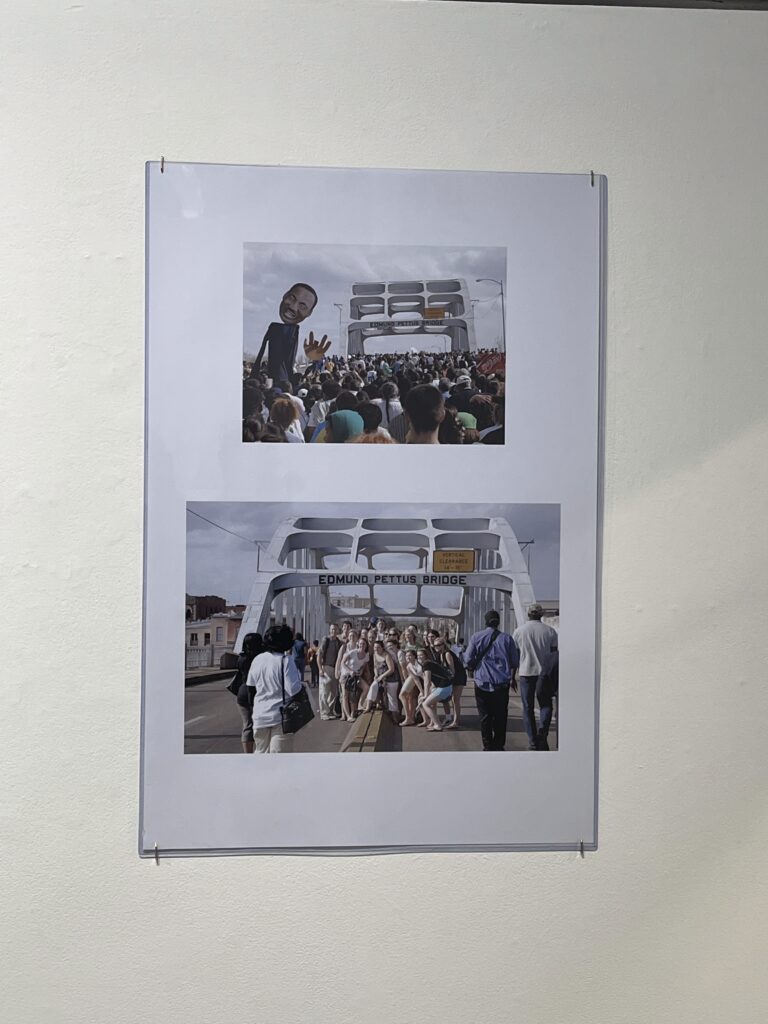 Kirkpatrick’s photographs of the 2015 crossing of the Edmund Pettus Bridge in Selma, Alabama
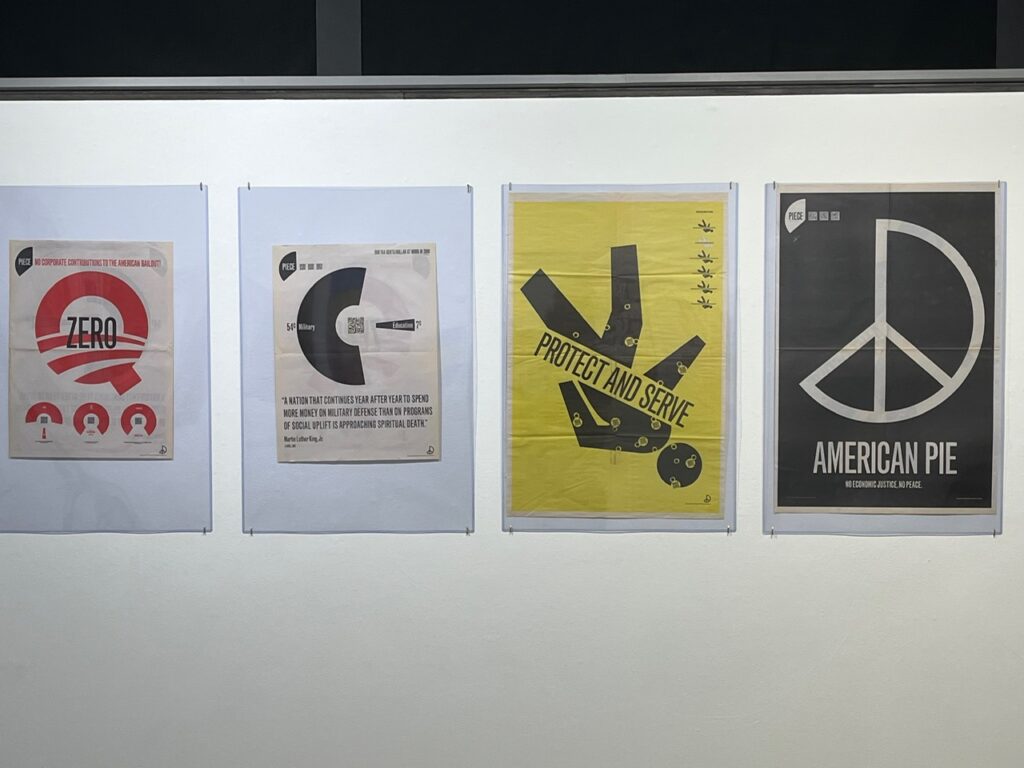 First edition of “American Pie,” a self-published newspaper produced circa 2008–2011
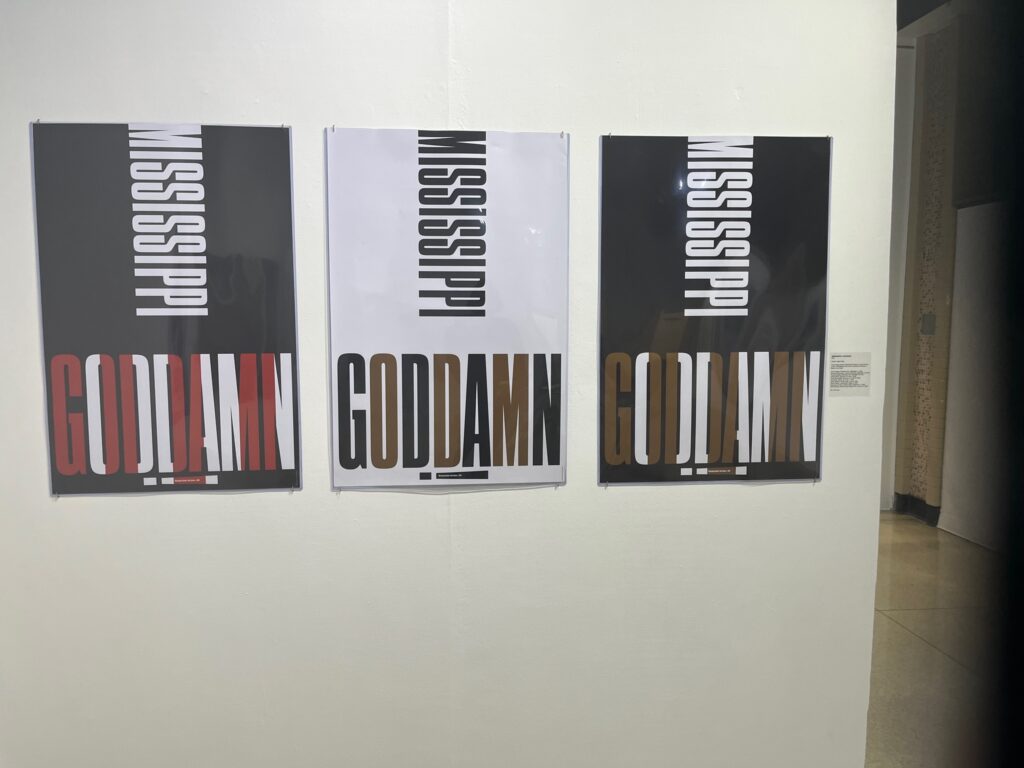 Triptych versions of Mississippi Goddam[n] memorialize the dozen or more recent lynchings of African Americans in the South in 2025 and 2026
 The poster diptych Take the Sheet Off Your Face, Boy… draws on metaphors from The Staple Singers song “Respect Yourself” to establish direct parallels between the hoods of the Ku Klux Klan and the masks worn by U.S. Immigration and Customs Enforcement (ICE) agents
 Kirkpatrick put out an open call for student-created yard signs. Printing on corrugated material, students explored their own perspectives on the issues shaping the election in response to the exhibition’s themes.
The exhibition’s title reflects an approach that merges personal experience, cultural observation, and graphic communication. “For me, auto (self), ethno (culture), and graphis (the Latin root associated with graphic mark-making) provide the visual complement to autoethnography. Beyond the anthropological practice of ethnographic observation, which lies at the core of User Experience Design, autoethnography uses autobiography to critically analyze the cultural and social forces that shape our lives. Autoethnographis is my visual dialogue with the moment we are living in.”
Bryant Keith Alexander, dean of the College of Communication and Fine Arts, writes: “Autoethnography, as a qualitative research methodology, is most often thought of as an approach to research and writing, that seeks to describe and analyze personal experience to understand and comment on culture. Professor Kirkpatrick’s extensive body of work engages visual narrative in civic engagement, historical memory, and social critique—furthers an argument for the power of visual communication in public debate—and how the artist locates themself in public discourse.”
For Kirkpatrick, art and design are ultimately acts of witness. In a media landscape crowded with competing messages, he believes creative work can preserve memory, foster dialogue, and inspire action. He often times exhibitions to coincide with elections and serve a dual purpose: presenting the work while also encouraging civic participation through voter registration drives.
“Art and design offer a powerful arsenal for confronting inequity and challenging dominant narratives,” Kirkpatrick says.
Kirkpatrick’s work draws heavily from graphic design, advertising, and popular culture, fields often associated with persuasion and commerce. Yet he sees those same visual languages as powerful tools for public discourse. “While design has proven an effective tool for branding and commerce, the use of words and images predates contemporary media,” Kirkpatrick says. “Advertising is a dominant visual language, deploying familiar clichés to shape our desires and consumption. Yet design can also be a democratizing medium. Designers have at their disposal the means of production. Through self-publishing—zines, posters, and art books—we can reclaim that agency. The authority of the printed word and the handmade object provides a tangible counterpoint to the ephemeral and the swipeable.”
That belief underscores his broader philosophy about the social responsibility of art and design. “Art and design offer a powerful arsenal for confronting inequity and challenging dominant narratives,” Kirkpatrick says. He draws inspiration from the work of Käthe Kollwitz, John Heartfield, and Sister Corita Kent, as well as contemporary artists such as Luba Lukova, Yossi Lemel, and Chaz Maviyane-Davies. “Their use of the human figure, visual metaphor, and typography in political communication offers enduring lessons in how images can inform, persuade, and provoke.”
Central to Kirkpatrick’s artistic and teaching practice is the idea of recontextualization, using familiar imagery, language, and symbols to encourage audiences to question assumptions and reconsider dominant narratives. “Appropriation and recontextualization build on our collective public memory, creating a bridge between the familiar and the unexpected,” he says. He often draws on vernacular imagery and popular idioms to develop new design concepts. “The messages are intentionally direct, delivering their meaning with immediacy. There is little time for nuance when the goal is to make an impact.”
Kirkpatrick brings this same approach into the classroom, where he encourages students to see graphic design as a means of interpretation and critical inquiry. “This process of translation—giving form to an idea or observation—is itself a form of visual intelligence. It enables students to move beyond passive consumption and become active interpreters and makers of visual culture,” he says.