


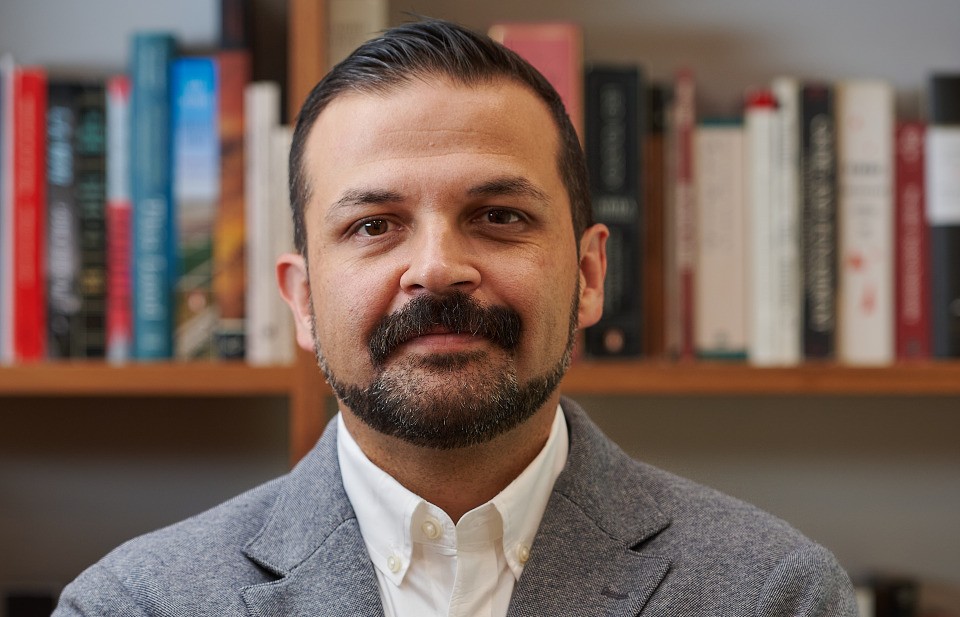
Jason Blakely joins the LMU Bellarmine College of Liberal Arts as a professor of philosophy, with wide-ranging interests in ethics, political philosophy, literature, phenomenology, religion, and beyond. “Although these interests might appear disparate, they all stem from my involvement in hermeneutic phenomenology—a tradition of philosophy that sees humans as meaning-making creatures,” he says.
What drew Professor Blakely to LMU was the intellectual range and dynamism of the philosophy faculty, the university’s Ignatian approach to education, the high value LMU’s curriculum places on the humanities, the centralizing presence of Catholicism, the beauty of the bluffs, and the general happiness and success of the students. Professor Blakely was also drawn to LMU’s embeddedness in Los Angeles, the city that he and his family love and call home.
Originally from Colorado, Blakely headed East for college, attending Vassar, where he received a transformative liberal arts education. After graduating, he tried his hand at writing novels while working at bookstores in New York City and Chicago. Ultimately, however, Blakely concluded that he was better suited to other forms of writing and decided to pursue a doctorate at U.C. Berkeley. In recent years, however, Blakely has fulfilled his early publishing dreams, writing books on the role of scientism in political life (“We Built Reality”) and the nature of ideology (“Lost in Ideology”). This summer, he published a book, “Utopia for Our Century,” with David Albertson (USC), on renewing hope through a creative reappropriation of Saint Thomas More’s invention of “utopian” politics, published by Yale University Press.
Professor Blakely taught at Pepperdine University for 13 years, and it was there where he learned that teaching in a deep humanistic way is an endlessly difficult and fascinating endeavor. “What I enjoy most in teaching is this process of expanding the range of the thinkable with my students. The life of the mind without students would be meaningless,” he says. This semester, Professor Blakely is teaching “Ethics” (PHIL 3100), which makes a sweeping journey from Aristotle through Kant and Mill to Nietzsche, as well as a survey of “Western Political Philosophy” (PHIL 3160) in which the main theme is ideal worldmaking going back to Plato, Cicero, Thomas More, and Francis Bacon, among others.
Professor Blakely hopes that students take away his belief that engaging in philosophy and the liberal arts transforms us by tapping into, and intensifying, our higher capacities that are unique to humanity. Blakely cares deeply about his students and communicates this through his dedication to passing down his own learning, the best he can.
The son of an Anglo-American father who practiced law and a Colombian immigrant mother who taught Romance Languages as an adjunct lecturer, Blakely grew up immersed in two languages, cultures, sensibilities, and literary traditions. As an adult, he also underwent a personal and spiritual transformation, converting from atheism to Catholicism. Together, these experiences have shaped his understanding of identity and belonging and continue to inform how he understands himself and engages with others.
“I live between worlds,” he says. “I am a Hispanic American with an Anglo name who is mixed-race and bilingual. I have roots in both America and América,” he says. “I have undergone many changes in my life,” he says. “I have learned over time to see these transformations as a gift that might help me meet and love the people I encounter across a wide variety of differences without reducing or dismissing them. That, anyway, is my hope.”
Outside the classroom, Professor Blakely enjoys exploring Los Angeles with his wife and two children and sharing meals with the people he cares about.