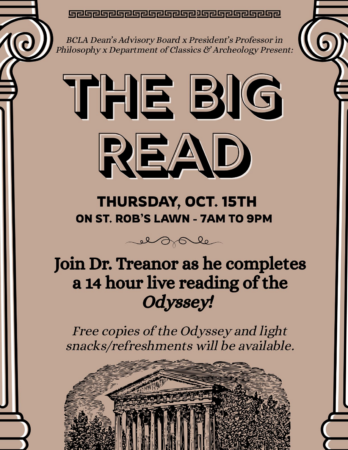
The “Odyssey” is having a moment. Christopher Nolan’s adaptation of the “Odyssey” was a massive box office hit. As was Emily Wilson’s acclaimed 2017 translation, the first complete English translation of the epic poem by a woman. And now, here at LMU, President’s Professor of Philosophy Brian Treanor will lead a complete cover-to-cover public reading of the Lombardo translation of the Odyssey – all 109, 540 words of it!
The marathon reading, or Homerathon if you will, will take place on Thursday, Oct. 15, on St. Robert’s lawn, between St. Robert’s and the Von der Ahe buildings. The reading will start at 7 am and continue until Athena, as it were, sings. Though Treanor estimates it will take about 12-14 hours. Students, faculty, and staff are invited to stop by for a few minutes, or stay for as long as they’d like. Copies of the text will be provided for participants to follow along, or take a turn reading. Students can also bring journals, sketchbooks, or other materials for non-disruptive activities to occupy or express themselves during the reading.
In the “Odyssey,” the Greek King Odysseus is on a journey home following the Trojan war, and in many ways, reading a great text like Homer’s “Odyssey” is a kind of journey. “It’s a window into a world other than your own. It takes a certain amount of time, attention, and engagement,” says Treanor. “When you finish it, you’re not really the same person who started it.”
Publications like the New York Times, the Atlantic, the Chronicle of Higher Education, and others have reported that people, especially young people, are losing the capacity for the kind of sustained attention necessary to become immersed in a text. Our culture is instead built for speed and efficiency, which can make people feel “less productive’ for devoting a lengthy block of time to reading or listening to a text. But one of the best ways to experience and enjoy a piece of literature is to lose yourself in the narrative world.
This is not the first time Treanor has hosted a “big read.” For Earth Day in 2025, he convened students, faculty, and community members for a continuous, public reading of Henry David Thoreau’s Walden. For Treanor, these events create opportunities to encounter great texts together as part of the everyday rhythm of campus life. They invite people to slow down, listen, reflect, and share in the experience of reading with others. He notes that Emerson opens “The American Scholar” with an observation about universities, which hold annual ceremonies as “a friendly sign of the survival of the love of letters amongst a people too busy to give letters any more.”
“But, like most loves, the love of letters does not happen in a sudden coup de foudre. It happens over time, as a person develops the ability to read in a sustained way, experiences a variety of different texts that open different worlds, and as a consequence finds their own world both broadened and deepened,” Treanor says.
Come experience the “Odyssey” on Oct. 15!